NEWS
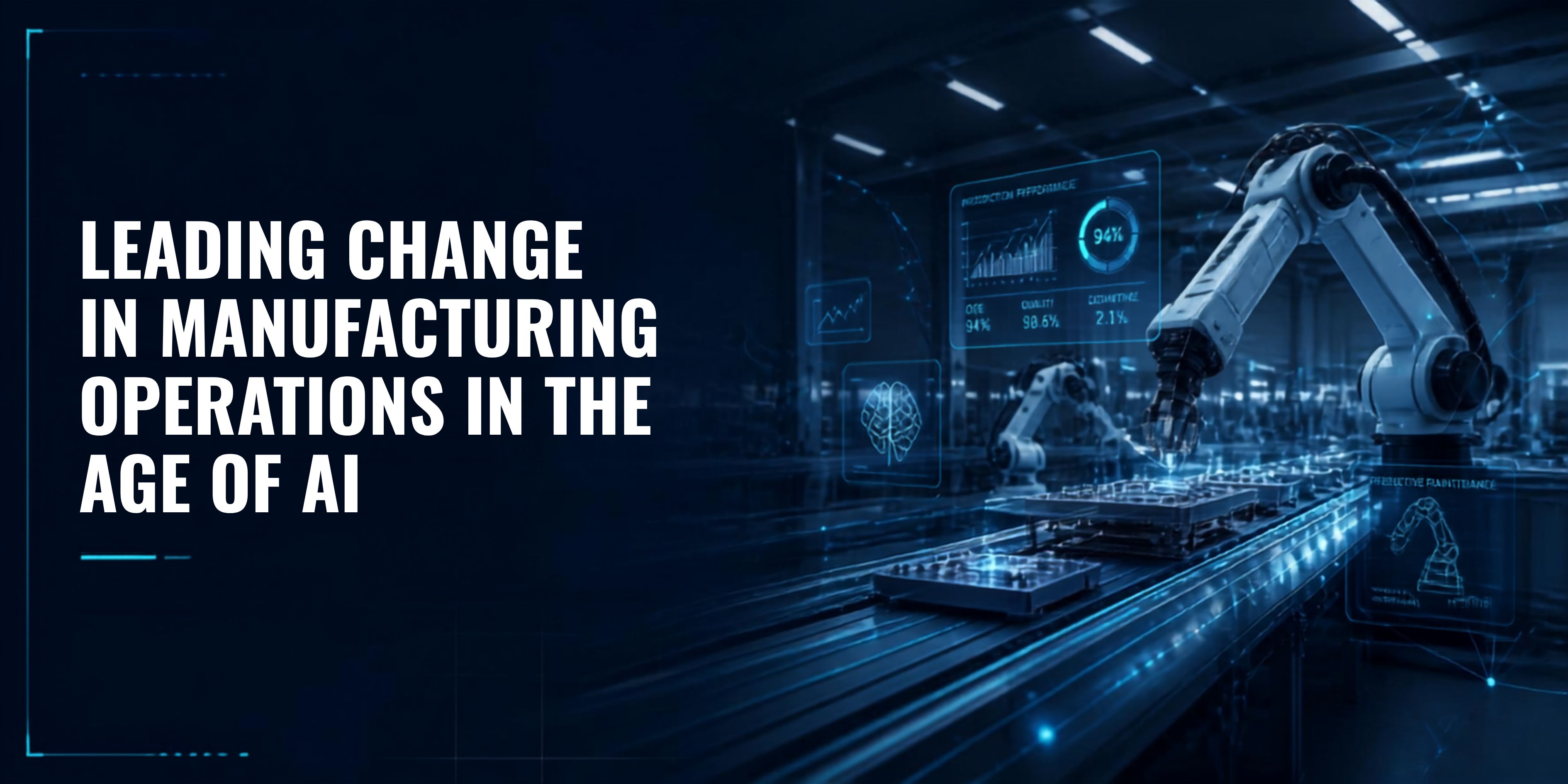
Artificial intelligence is no longer a future concept in manufacturing—it is already reshaping operations across the globe. From predictive maintenance and automated quality inspection to production scheduling and supply chain optimization, AI is becoming a foundational capability for competitive manufacturers. According to Deloitte’s manufacturing outlook, more than half of manufacturers are already using generative AI tools in some part of their operations. Meanwhile, industry analysts project the global AI-in-manufacturing market to grow from approximately $34 billion in 2025 to more than $155 billion by 2030.
Yet despite this momentum, many AI initiatives fail to deliver meaningful results. Research summarized from McKinsey’s State of AI reporting shows that while AI adoption is widespread, most organizations remain stuck in pilot phases and struggle to scale implementation successfully. Other studies point to unclear strategies, workforce resistance, in adequate leadership alignment, and poor change management as primary reasons for failure—not the technology itself.
This reality creates an important lesson for manufacturing leaders: AI adoption is a technical transition, but success or failure is usually determined by leadership, culture, and workforce adoption.
Manufacturing organizations that thrive during the AI evolution will not necessarily be those with the most advanced software. They will be the companies that successfully lead people through operational transformation while maintaining trust, engagement, productivity, and clarity of purpose.
Manufacturing operations are built around consistency, repeatability, safety, and reliability. Many employees have spent years mastering processes and workflows that define operational success. AI introduces uncertainty into that environment.
Employees commonly fear job displacement, loss of expertise or relevance, increased monitoring, complexity and confusion, reduced control over operations, and rapid process changes.
These concerns are understandable. In many facilities, workers have already experienced multiple waves of automation, ERP implementations, lean initiatives, or digital transformation programs that failed to meet expectations. When AI is introduced poorly, employees may see it as “another management initiative” disconnected from operational realities.
Successful AI transformation requires leaders who can connect technological change to operational purpose, employee growth, and business sustainability.
Organizations that succeed tend to start with clearly defined operational problems and focus on a small number of high-value use cases. They involve frontline employees early, align leadership around measurable outcomes, invest heavily in workforce capability, and build trust before scaling technology.
Organizations that struggle often chase trends instead of operational needs. Organizations that fail often implement AI without a clear strategy, chase trends instead of operational needs, overcomplicate deployments, ignore cultural resistance, underinvest in training, and treat AI as an IT initiative instead of an operational transformation.
In manufacturing, this focused approach is critical because operations environments are highly interconnected. A poorly implemented AI initiative can disrupt scheduling, maintenance, quality, staffing, or customer delivery performance.
Change management is the structured process of helping people move from their current state to a desired future state. One of the most practical frameworks for understanding resistance during operational transformation is Gleicher’s Formula for Change. Gleicher’s Formula for Change provides a guide to assist leaders through change management initiatives. It explains change occurs when:
D (Dissatisfaction) x V (Vision) x F (First Steps) > R(Resistance to Change)
For employees to embrace change, they must understand:
Note this formula is multiplicative, not additive. If any of these elements are missing, change does not occur.
Without effective change management, even technically sound AI solutions can fail because employees resist adoption, distrust recommendations, or revert to old processes.
Manufacturing leaders must recognize that AI adoption is both a technical and emotional transition.
D — Create Dissatisfaction with the Current State
Manufacturing leaders must help employees understand why AI adoption is necessary. Leaders should connect AI initiatives to real operational pressures such as labor shortages, downtime, quality challenges, supply chain volatility, safety concerns, and increasing customer expectations. The goal is to build awareness that maintaining the status quo may create greater risk than evolving operations.
V — Build a Clear and Credible Vision
Employees need a clear picture of how AI will improve operations. Leaders should position AI as a tool to improve safety, quality, decision-making, responsiveness, and operational efficiency while supporting—not replacing—employees. Leadership alignment across operations, engineering, maintenance, IT, HR, and executive teams is essential to communicate a consistent vision and measurable objectives.
F — Define Clear First Steps and Early Wins
Manufacturers should begin with focused, high-value applications such as predictive maintenance, quality inspection, scheduling optimization, energy management, and inventory forecasting. Frontline employees should be involved early to identify operational realities, improve buy-in, and reduce resistance. Training should focus on AI literacy, human-machine collaboration, and practical operational use cases.
R — Reduce Resistance Through Trust and Continuous Improvement
Resistance decreases when leaders communicate transparently about how AI works, what data is being collected, where human oversight remains essential, and how performance will be measured. Manufacturers should continuously monitor adoption, employee engagement, operational performance, and ROI while gathering employee feedback and adjusting processes through continuous improvement practices.
The manufacturing industry has successfully navigated multiple technological revolutions—from mechanization and electrification to automation and digital connectivity. AI represents the next major evolution.
But unlike earlier waves of automation, AI directly influences decision-making, knowledge work, and operational intelligence. That makes leadership even more important.
The future manufacturing leader must become a communicator, a coach, a technology translator, a culture builder, and a strategic change leader.
Facilities that succeed with AI will not succeed because they deploy better algorithms alone. They will create cultures that embrace learning, adaptability, collaboration, and continuous improvement.
Manufacturers that successfully combine operational vision, workforce trust, and disciplined change leadership will be best positioned to turn AI from experimentation into long-term competitive advantage.

CEO of the Industry 4.0 Club, Mike Ungar is a FocalPoint Business Coach and Executive Coach helping business leaders improve their profitability and achieve their personal and professional goals. Mike is also a Co-Founder of the Industry 4.0 Club and helps to drive its purpose of engaging the power of diverse worldwide talent to accelerate the global evolution to Industry 4.0.
After graduating from the United States Military Academy, he served as an Infantry Officer in the United States Army. Upon completion of his military service, Mike joined Michelin North America. In his 35 years at Michelin, Mike coached teams from all areas of business (manufacturing, research and development, sales and marketing, and support services) as well as in a variety of countries and cultures (France, Germany, Romania, Northern Ireland, Brazil, Mexico, Canada, and the United States). He also led teams in manufacturing, continuous improvement, and personnel. Mike has leveraged his coaching experience with Lean techniques to develop sustained continuous improvement culture through the engagement of people.
Mike is on the Board of the Upstate Veteran’s Business Network and helps Veterans Transitioning to Civilian life. He is a member of the Workplace Advisory Council to the Tanenbaum Center for Interreligious Understanding and is co-chair of the Greenville Society of Human Resource Management’s Diversity, Equity, and Inclusion committee.
NEWS